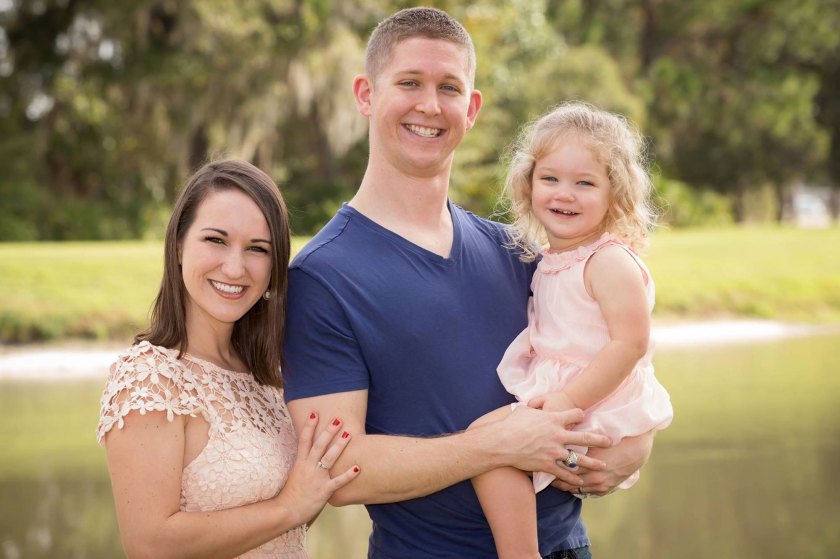
When Stephanie first began getting headaches last November, she wasn’t terribly worried because they “came and went,” she says.
By January, they became more constant with no relief from the pain, so she decided to go to her doctor to get checked out.
When the diagnosis came on Feb. 16, it was worse than anything she could have imagined. She had a grade 4 glioblastoma — the most aggressive, deadly brain tumor there is — on her brain stem. Without removal and treatment, patients typically die within a few months, experts say. Even with treatment, without removal the average survival rate is 15 months, doctors told her.
“The doctor said because of the location, they weren’t willing to operate; that it was too risky,” Stephanie, who asked that her last name not be used to protect her family’s privacy, tells PEOPLE. “They decided to leave it and just press forward with radiation and chemotherapy and hope for the best.”
She and her husband Michael consulted three other top neurosurgeons in the country who also refused to try to remove it, she says.
“I was a young mom and wife and I really felt like they gave me a death sentence,” she says. “Everything we’d read about glioblastomas said you need surgery to remove it if you stand a chance.”
Devastated, Stephanie started a blog, mainly to update her friends and family but also to capture everything she was feeling.
“So I have the worst kind of cancer in the worst place possible,” Stephanie wrote on Feb. 18. “Hearing that statistically I have 15 months to live is just heartbreaking. I’m only 27 years old, I have a beautiful 2-year-old daughter and I love my husband more than anything on this earth. How could this be happening!?”
Miraculously, that blog somehow found its way to Dr. Michael Sughrue, a neurosurgeon at OU Medical Center in Oklahoma City who specializes in removing brain tumors other doctors say are inoperable. He immediately posted a comment.
“I wrote, ‘Hey, I’m a neurosurgeon. I specialize in very difficult brain tumors. Not all of these things are really inoperable. Why don’t you show me your films and I can see if I can do something to help you,’ ” Sughrue, 38, tells PEOPLE. “Within five minutes she emailed me and said, ‘What do I need to do?’ ”
She sent him the MRIs of her tumor. After reviewing them he told her he thought he could help her.
“I said, ‘I can get at least most of this out without too much risk but here’s what the risks are,’ ” he says.
Stephanie and her husband, who were on their way to Disney World in Orlando, were floored by his reaction.
“He said, ‘Honestly, I thought it would be much worse than what you showed me,’ ” says Stephanie. “I thought he was going to tell us the same thing the other doctors did. I really didn’t think he’d tell us he could do it.”
Author: NICOLE WEISENSEE EGAN

